Choosing the right popcorn popping method is an important decision for manufacturers planning a new production line or upgrading an existing factory. Different popcorn products do not always require the same processing method. Butterfly popcorn for cinemas, jumbo popcorn for snack brands, caramel popcorn for retail packaging, and large-volume plain popcorn may have different requirements for expansion, texture, flavor coating, and production capacity.
So, how should manufacturers select a popping method for different popcorn product requirements? The decision should be based on the finished product, target output, kernel characteristics, flavoring process, and level of automation. Electromagnetic popping, hot-air popping, and traditional kettle popping each have their own advantages and suitable applications.
XFD provides industrial popcorn equipment and production lines using different popping technologies. Instead of choosing a machine simply because it has a higher rated capacity, manufacturers should first identify what type of popcorn they need to produce and how the finished product will be processed, coated, and packaged.
Why Does the Popcorn Product Determine the Popping Method?
Before comparing machines, manufacturers should define the product they want to make. Different popcorn products have different requirements for kernel expansion, shape, surface structure, flavor absorption, and finished texture.
For example, cinema popcorn is often produced in butterfly or mushroom-style forms depending on the product and kernel used. Caramel popcorn needs a suitable surface structure and processing arrangement for an even coating. Jumbo popcorn requires kernels and popping conditions capable of producing larger expanded pieces.
These differences affect equipment selection in several ways:
- Expansion requirements: The popping method should be suitable for the desired popcorn shape, size, and expansion characteristics.
- Texture requirements: Some products need a light and crisp texture, while others require a structure suitable for coating or further processing.
- Flavoring requirements: Plain popcorn, butter-flavored popcorn, caramel popcorn, and powdered-seasoning products may require different downstream equipment.
- Production volume: A small snack shop and a factory supplying distributors do not need the same output or automation level.
- Operating costs: Heating energy, labor, cleaning, maintenance, and material handling should all be considered.
A useful starting point is to decide whether the factory mainly produces plain popcorn, flavored popcorn, or multiple product types. This helps narrow down the suitable popping technology before comparing individual machines.
What Are the Main Popcorn Popping Methods Used in Commercial Manufacturing?
Commercial and industrial popcorn production generally uses several heating approaches. The main options include electromagnetic heating, hot-air popping, and traditional heated-kettle popping.
Although all three methods turn popcorn kernels into expanded popcorn, they differ in how heat is transferred, how the production cycle is organized, and how the equipment fits into a complete manufacturing process.
Electromagnetic popping
Electromagnetic popcorn machines use electromagnetic heating technology to heat a suitable metal kettle. The kernels are processed inside the heated kettle, generally together with the required oil and other ingredients according to the recipe.
This method is suitable for manufacturers who need controlled batch production and relatively fast heating cycles. Industrial configurations can use multiple machines to increase total output. XFD's electromagnetic equipment is designed for industrial applications that require higher production efficiency and coordinated processing.
Hot-air popping
Hot-air popcorn machines use heated air to pop kernels. Instead of relying on a conventional oil-heated kettle for the popping process, the equipment uses controlled airflow and temperature to transfer heat to the kernels.
This method can be considered when manufacturers want to use a hot-air processing approach or develop a production line in which popping and subsequent flavoring are arranged as coordinated stages. The final recipe may still involve oil, caramel, chocolate, or other coating ingredients after popping.
Traditional heated-kettle popping
Traditional kettle machines heat kernels inside a cooking kettle using conventional heating elements or another suitable heat source. They are commonly used in cinemas, snack shops, concession stands, and other commercial venues.
These machines can be practical for businesses that produce popcorn in batches for immediate serving. However, factories with much higher output requirements may need multiple machines or a more integrated industrial production system.
When Should Manufacturers Choose Electromagnetic Popping?
Electromagnetic popping is worth considering when a manufacturer needs efficient batch production, controlled heating, and the ability to expand output through a suitable industrial configuration.
One important advantage is the way electromagnetic technology transfers heat to the cooking kettle. It can provide responsive heating and support shorter production cycles in suitable equipment configurations. However, actual performance still depends on kettle design, power supply, kernel characteristics, batch size, and operating conditions.
Electromagnetic popping is particularly relevant for:
- Factories producing butterfly or jumbo popcorn in industrial quantities.
- Manufacturers that need repeatable batch processing.
- Businesses producing several popcorn flavors with different recipes.
- Factories planning to increase capacity by adding additional popping machines.
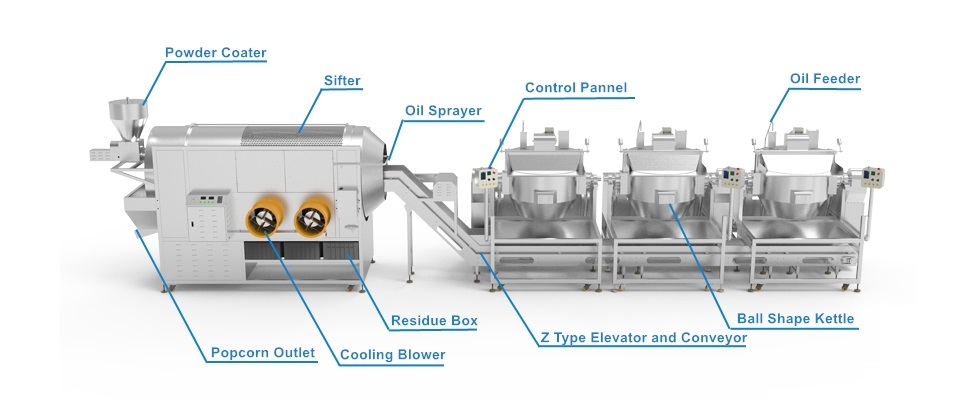
- Production systems that require integration with oil feeding, conveying, cooling, and coating equipment.
For example, XFD's industrial electromagnetic popcorn production line with multiple machines uses two electromagnetic popcorn machines and is listed with an output of approximately 160 kg/h. The manufacturer states that the configuration can produce both butterfly and jumbo popcorn.
This is a specification for the listed two-machine configuration, not a guaranteed output for every electromagnetic popcorn system. Actual production should be confirmed according to the kernel type, recipe, operating schedule, and complete production-line arrangement.
For manufacturers comparing industrial equipment, electromagnetic popping is a practical option when batch control, production efficiency, and capacity expansion are important selection factors.
When Is Hot-Air Popping a Better Choice?
Hot-air popping is suitable for manufacturers who want to produce popcorn using heated airflow rather than relying on oil inside a conventional popping kettle. It is especially relevant when the product concept requires a hot-air popping process or when the factory plans to apply flavoring and coating after popping.
One important consideration is that hot-air popping and the final flavoring process are two separate stages. A manufacturer may pop the kernels using heated air and then add caramel, chocolate, cheese, or powdered seasoning through a downstream coating system.
Hot-air popping may be worth considering for:
- Manufacturers developing hot-air-popped popcorn products.
- Factories that want to separate the popping stage from the flavoring stage.
- Production lines designed around hot-air ovens and controlled airflow.
- Businesses producing flavored popcorn that requires subsequent caramel or chocolate coating.
- Factories that need a modular system with options for increasing capacity.
XFD offers a factory hot-air popcorn machine and caramelizer production line designed to combine hot-air popping with large-scale flavoring and coating equipment.
The listed configuration is intended for approximately 180–250 kg/h of caramel or chocolate popcorn output. Its product description also explains that additional popcorn machines and caramelizers can be added to expand production capacity. This figure refers to the specified line and finished-product application, rather than the output of every hot-air machine.
When evaluating this type of system, buyers should ask whether the quoted capacity refers to raw popped popcorn or finished coated popcorn. They should also confirm the expected output using their intended kernel variety and coating recipe.
Is Traditional Kettle Popping Still Suitable for Commercial Popcorn?
Yes. Traditional kettle popping remains useful for many commercial applications, especially where popcorn is prepared in batches and served directly to customers.
Cinemas, food courts, amusement parks, snack shops, and concession stands often need equipment that can produce fresh popcorn in manageable quantities throughout the day. In these situations, a traditional kettle machine can be a practical choice.
Traditional kettle popping is worth considering when:
- The business has moderate or relatively predictable popcorn demand.
- Popcorn is prepared close to the point of sale.
- Operators need a straightforward batch production process.
- The available installation space is limited.
- The business does not require a complete factory-scale production line.
However, traditional kettle equipment should not automatically be treated as the best choice for every factory. When production demand increases, manual loading, unloading, oil feeding, and product transfer may become limitations. Manufacturers should compare the complete operating workflow rather than looking only at the initial machine price.
For businesses serving cinemas and concession locations, XFD also provides cinema popcorn machines in different kettle configurations for commercial popcorn preparation.
Which Popping Method Is Best for Different Popcorn Products?
There is no single popping method that is best for every popcorn product. The most suitable option depends on the product's expansion characteristics, flavoring requirements, and expected production volume.
| Popcorn Product | Popping Method to Consider | Important Selection Factors |
|---|---|---|
| Cinema butterfly popcorn | Electromagnetic or traditional kettle popping | Batch cycle, kettle size, expansion, and serving demand |
| Jumbo popcorn | Electromagnetic or suitable hot-air equipment | Kernel variety, expansion volume, and product size |
| Caramel popcorn | Electromagnetic or hot-air popping with a suitable caramelizer | Surface condition, coating uniformity, and cooling capacity |
| Chocolate-coated popcorn | Electromagnetic or hot-air popping with a coating system | Popping consistency, coating temperature, and product handling |
| Powder-seasoned popcorn | Electromagnetic or hot-air popping with a seasoning system | Surface contact, seasoning adhesion, and mixing performance |
| Small-batch gourmet popcorn | Traditional kettle or compact hot-air equipment | Recipe flexibility, batch size, and operating convenience |
This table provides a starting point for equipment selection. The final method should be confirmed through actual kernel tests and production trials. For example, a manufacturer producing jumbo popcorn should first verify that the selected kernel variety and machine configuration can achieve the required expansion before investing in a full production line.
How Do Kernel Type and Expansion Requirements Affect Equipment Selection?
The popping method is only one part of the production decision. Kernel variety is equally important because different popcorn kernels do not necessarily produce the same shape, expansion volume, or texture.
Butterfly popcorn typically has irregular wings and a light structure. It is commonly used for cinema popcorn and products intended for direct consumption. Mushroom-style or jumbo popcorn has a more rounded structure and may be preferred for products that need a stronger shape during coating and handling.
Before choosing a machine, manufacturers should confirm the following raw material information:
- Kernel variety: Confirm whether the supplier provides butterfly, mushroom, or another suitable popcorn variety.
- Kernel moisture: Check whether moisture content is within the supplier's recommended range.
- Kernel size: Compare size distribution and physical consistency between deliveries.
- Expansion performance: Conduct a popping test to evaluate volume, shape, and unpopped kernel rate.
- Coating suitability: Check whether the popped product can withstand the intended mixing and coating process.
A machine should not be selected based only on the name of the popping technology. The combination of kernel type, heating conditions, and product requirements determines the actual result.
For this reason, manufacturers should provide representative raw kernels and their intended product specifications when discussing a new machine with an equipment supplier. A sample test is often more useful than relying on general performance descriptions.
Why Should Flavor Coating Be Considered Before Choosing a Popping Method?
Many factories do not sell plain popcorn alone. Their product range may include caramel, chocolate, cheese, butter, strawberry, or other flavored popcorn. In these cases, equipment selection should consider the entire process from popping to finished-product packaging.
For example, caramel popcorn needs a suitable coating process to distribute the syrup evenly across the popped kernels. Chocolate-coated popcorn may require different temperature and handling conditions. Powder-seasoned popcorn depends on suitable mixing and surface contact to achieve consistent flavor distribution.
These requirements can influence the preferred popping method because the popping equipment must supply popcorn at a rate and product condition that the coating system can handle.
XFD provides industrial popcorn coating machines for different flavoring applications. When selecting a complete production line, buyers should check the coating capacity, heating requirements, mixing method, cleaning process, and compatibility with the popping equipment.
It is also important to consider cooling after coating. Popcorn may need to pass through a cooling and separation stage before packaging to help prepare the product for handling and storage.
For manufacturers producing multiple flavors, a line that supports practical recipe changes and cleaning can be more useful than a system selected only for maximum hourly output.
How Should Manufacturers Compare Production Capacity and Operating Costs?
Production capacity is one of the most important purchasing factors, but the rated output of a single popping machine does not always represent the finished-product output of the entire factory.
When comparing different popping methods, manufacturers should evaluate:
- Rated hourly capacity: How many kilograms of popcorn the specified machine or production line is designed to process.
- Actual production cycle: How much time is needed for feeding, popping, unloading, and preparing the next batch.
- Labor requirements: Whether operators need to manually load kernels, add oil, transfer popcorn, or control coating.
- Energy consumption: The power requirements and energy use under the intended operating conditions.
- Downstream capacity: Whether cooling, coating, conveying, and packaging can handle the popping output.
- Maintenance and cleaning: How easily the equipment can be cleaned, inspected, and maintained between production runs.
- Product changeovers: How much time is needed when changing flavors, recipes, or kernel varieties.
For example, a factory may select a popping machine rated at 100 kg/h, but if its coating equipment can only process 70 kg/h, the complete line cannot continuously deliver 100 kg/h of finished coated popcorn. The actual output is limited by the stage with the lowest effective capacity.
Manufacturers should therefore ask suppliers for the expected output of the complete production line using the intended product and recipe. They should also clarify whether the capacity refers to raw kernels, popped popcorn, or finished flavored popcorn.

What Should Buyers Check Before Ordering a Popcorn Production Line?
Before placing an order, manufacturers should prepare clear product and production information. This helps the equipment supplier recommend a system that matches the actual factory requirements instead of offering a machine based on output alone.
A practical purchasing checklist includes:
- Finished product: Plain, butterfly, jumbo, caramel, chocolate, cheese, or other flavored popcorn.
- Target capacity: Required output in kg/h and expected daily production hours.
- Kernel specifications: Variety, size, moisture range, and supplier information.
- Popping method: Whether electromagnetic, hot-air, or traditional kettle processing is preferred.
- Flavoring process: Required caramelizer, seasoning mixer, or coating equipment.
- Automation level: Manual, semi-automatic, or fully automatic operation.
- Installation conditions: Factory space, electrical supply, ventilation, and utility requirements.
- Future expansion: Whether additional popping machines or coating equipment may be needed later.
It is also worth asking whether the supplier can test the intended raw kernels and product recipe. This provides a more realistic reference for expansion, texture, coating performance, and production capacity.
For factories that need an integrated system, XFD's industrial popcorn production equipment range includes different configurations for factory-scale popping and processing. The final equipment combination should be selected according to the required product, production volume, and downstream process.
Packaging should also be considered during the planning stage. A suitable popcorn packaging machine helps match the final packing process to the actual production output and package format.
Frequently Asked Questions About Selecting a Popcorn Popping Method
Which popping method is best for industrial popcorn production?
There is no single best method for every factory. Electromagnetic popping is worth considering for controlled batch production and industrial capacity expansion. Hot-air popping is suitable for production systems designed around heated airflow and subsequent flavoring. Traditional kettle popping is commonly used for cinemas, snack shops, and smaller commercial operations.
What is the difference between electromagnetic popping and hot-air popping?
Electromagnetic popping uses electromagnetic heating to heat a suitable metal kettle, where kernels are processed in batches. Hot-air popping uses heated airflow to transfer heat to the kernels. The two methods have different equipment structures and process arrangements, so manufacturers should compare them according to product requirements and production targets.
Is hot-air popping suitable for caramel popcorn?
Yes. Hot-air popping can be used to produce popcorn that is subsequently processed through a caramel coating system. The popping stage and coating stage should be designed to work together, with suitable capacity and temperature control for the intended recipe.
Which popping method is suitable for jumbo popcorn?
Electromagnetic and suitable hot-air equipment can both be considered for jumbo popcorn production. The final result depends on the kernel variety, machine configuration, heating conditions, and operating settings. Manufacturers should conduct sample tests to confirm the required expansion size and shape.
Can one popcorn production line make different flavors?
Yes, a properly configured production line can support different popcorn flavors by using suitable coating and seasoning equipment. However, recipe changes may require adjustments to coating ingredients, operating conditions, cleaning procedures, and production settings.
Does a higher rated capacity always mean a better popcorn machine?
No. A machine should match the factory's actual production demand. Buyers should also consider labor, energy consumption, product changeovers, maintenance, and downstream equipment capacity. A high-output popping machine may not deliver the same output as finished packaged popcorn if the coating or packaging stages cannot keep up.
Should manufacturers choose batch or continuous popcorn production?
Batch production can be suitable when manufacturers need recipe flexibility, controlled batches, or a configuration that can be expanded by adding machines. Continuous or integrated processing may be considered when the factory needs a coordinated high-volume workflow. The suitable arrangement depends on the product, equipment design, and actual production requirements.
What information is needed to select an industrial popcorn popping machine?
Manufacturers should provide the target output in kg/h, kernel variety, desired popcorn shape and texture, product flavors, coating requirements, automation preference, available factory space, and electrical supply. These details help the supplier recommend a suitable machine and production-line configuration.
Can manufacturers use the same popping settings for every kernel variety?
Not necessarily. Different kernel varieties may respond differently to heating because of differences in size, moisture, and physical characteristics. Manufacturers should confirm suitable operating settings through sample tests and maintain separate production records for different raw materials when necessary.
Choosing a popcorn popping method should start with the finished product, not the machine. Manufacturers who define their product type, kernel specifications, required output, and flavoring process first can make a more practical equipment decision.
Whether a factory needs electromagnetic batch popping, hot-air production, or a traditional commercial kettle system, XFD provides popcorn equipment and production solutions for different business requirements. Visit XFD Popcorn to explore available machines and discuss a suitable configuration for your popcorn manufacturing project.