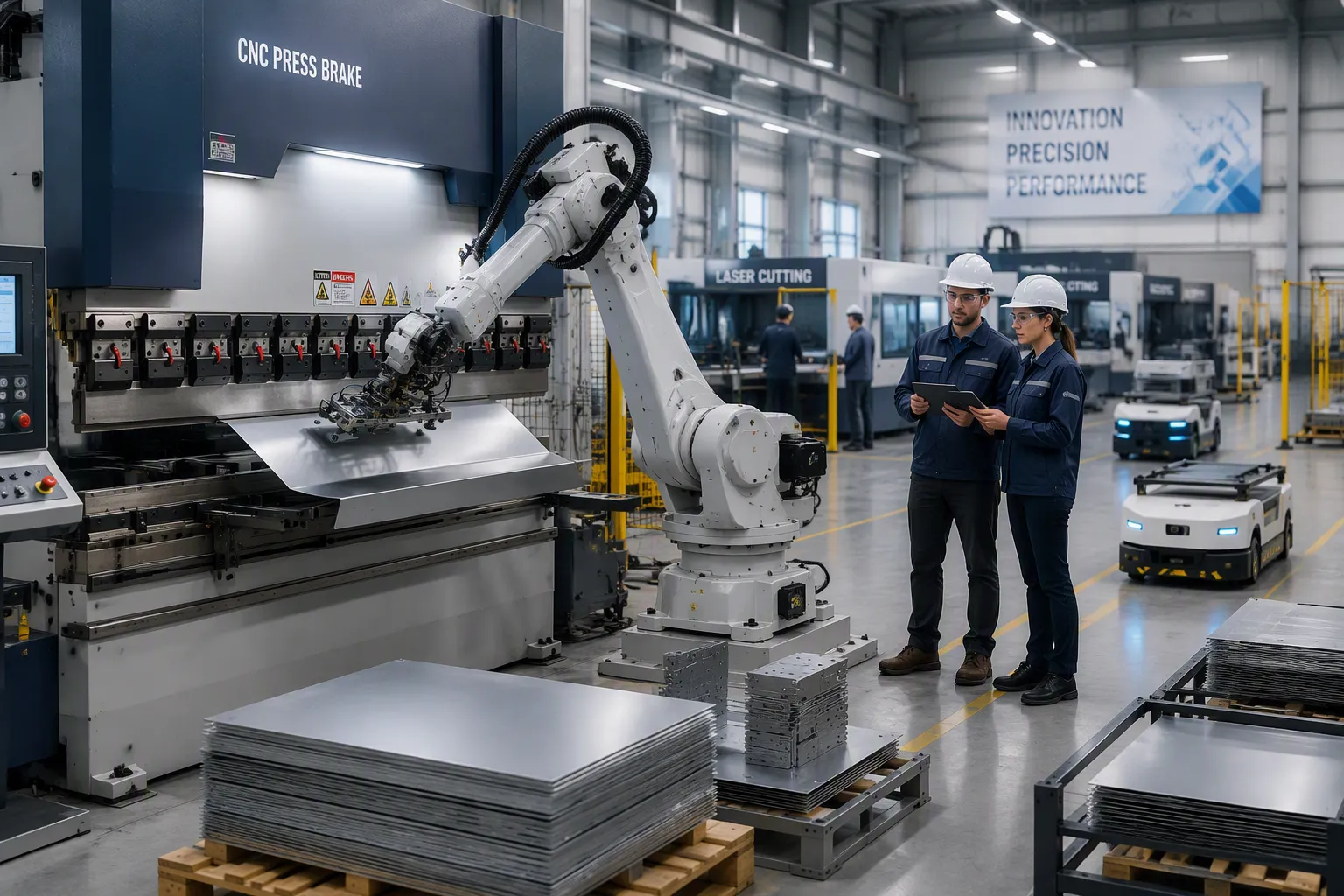
In 2026, key sheet metal manufacturing trends—automation, digitalization, sustainability, and supply chain shifts—reshape the industry. You see a global market projected to grow from $336.94 billion, expanding at a 5.7% CAGR. Adopting these trends gives you measurable advantages in speed, precision, and cost efficiency. Prepare for this shift. HPS stands ready to help you navigate this transformation with advanced fabrication solutions.
Key Takeaways
-
Automation and robots make production faster and safer. They help you save money and improve quality.
-
Digital tools like IoT and digital twins give you real-time data. You can make better decisions and reduce waste.
-
Sustainability and new materials lower costs and help the environment. You stay competitive and meet regulations.
Automation and Robotics Transform Production
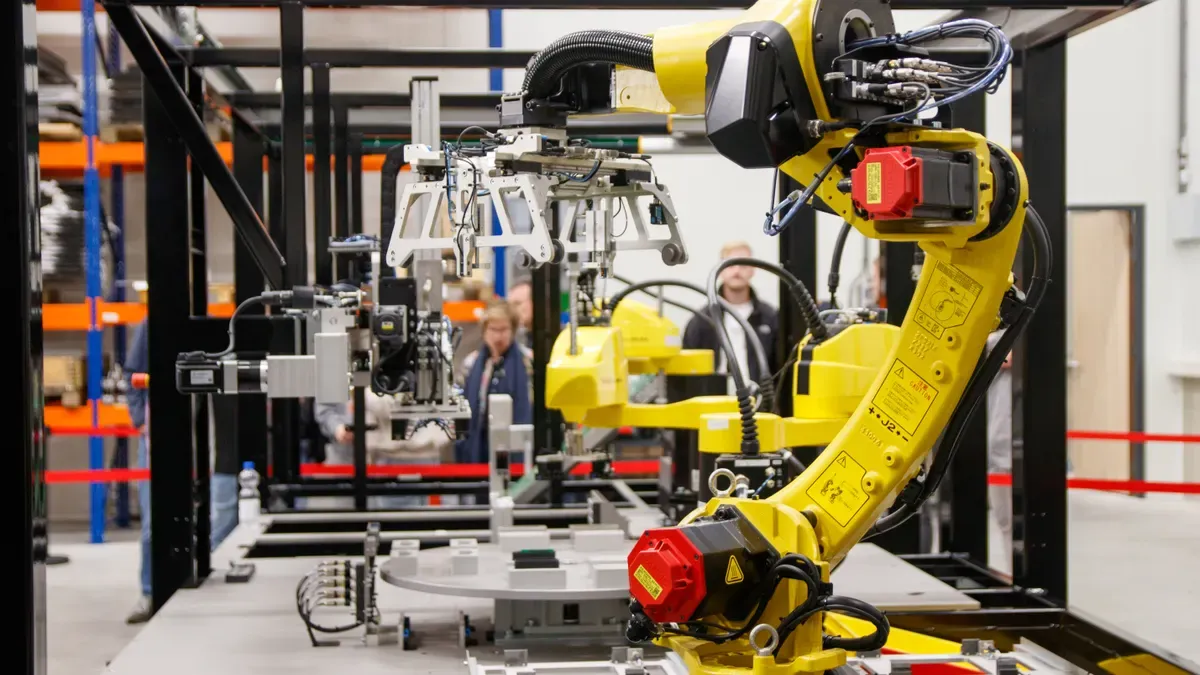
Automation and robotics are no longer optional investments in sheet metal manufacturing. They are foundational technologies that separate competitive fabricators from those falling behind. You see this shift across every production floor, from small job shops to large-scale industrial operations. The integration of collaborative robots, automated material handling, and intelligent press braking systems creates a new production paradigm. This paradigm prioritizes speed, precision, and adaptability.
Collaborative Robots on the Factory Floor
Collaborative robots, or cobots, represent a fundamental change in how you deploy automation. Unlike traditional industrial robots, cobots work safely alongside your employees without protective caging. Force-limiting sensors built into each joint measure torque hundreds of times per second. When a cobot's arm meets unexpected resistance, it reacts instantly by halting or reversing its motion. Safety-rated scanners and cameras monitor speed and separation, allowing the machine to slow as a person approaches. These capabilities eliminate the need for bulky safety cages, enabling fenceless automation. You can place cobots exactly where work happens, such as next to a press brake feeding sheet metal blanks.
Unlike their predecessors, Cobots are designed to work alongside human employees without protective caging. They are characterized by their force-sensing capabilities, allowing them to stop instantly upon contact, and their ease of programming, often achieved through simple hand-guiding (or "teaching"). The most profound impact of Cobots is not on the balance sheet, but on the humanization of work, transforming dull, dirty, and dangerous tasks into collaborative, high-value roles.
The operational advantages of cobots extend far beyond safety. When a cobot takes over tasks requiring awkward reaches or heavy lifting, ergonomics improve dramatically. Your workers experience fewer strains and repetitive-motion injuries, which lowers workers' compensation costs and improves job satisfaction. Cobots also help bridge the skilled-labor gap. A single operator can supervise multiple cobot stations, making scarce expertise go further across your production floor.
The table below illustrates how cobots compare to traditional robots across key operational dimensions.
|
Feature |
Traditional Robots |
Collaborative Robots (Cobots) |
|---|---|---|
|
Programming |
Requires dedicated programming support |
Easy to program and redeploy; touchscreen or hand-guided |
|
Space |
Needs dedicated safety systems and major line redesigns |
Takes up less space; no fencing required |
|
Cost |
High integration cost |
Lower upfront investment and integration cost |
|
Safety |
Requires full enclosures; too risky for proximity to humans |
Designed to be safe around people; integrated safety systems comply with global safety standards |
|
Flexibility |
Difficult to move and reprogram |
Can be used for various tasks with minimal setup; scalable architecture |
|
Deployment |
Long lead times |
Fast deployment with minimal disruption |
Production consistency improves when you deploy cobots for repetitive tasks. A cobot repeats the same path every cycle, which tightens dimensional variation across your production runs. Pairing the robot with barcode readers or vision cameras enables data collection on every part. Traceability becomes easier when each component's serial number, torque value, or weld timestamp is logged automatically. This supports ISO certifications and customer quality requirements without adding administrative burden.
The productivity gains from cobot deployment are measurable and significant. Continued cobot operation during two 15-minute breaks and a 30-minute lunch break per day increases production by 12.5% over an 8-hour shift. Flexible part presenters, machine process monitoring, and tool wear compensation can further increase production at the close of normal business hours. This often enables an unattended second shift. A single cobot can support two or even three machines, with one operator keeping the cells supplied with parts. Consider the case of EMI, a sheet metal fabricator in Ohio. The company operates two ProCobot flexible part presenter cells with UR10e robots for tending Hurco CNC machines. Since implementation, EMI has added over 1,200 to 1,600 production hours per automated machine annually. Cobot automation is precise and repeatable cycle after cycle. Built-in force sensing ensures blanks are aligned and properly seated, which reduces scrap from misaligned parts.
Automated Material Handling and Press Braking
Material handling represents one of the most labor-intensive aspects of sheet metal fabrication. Automated systems transform this bottleneck into a source of competitive advantage. Robotic loading and unloading mechanisms, combined with precise positioning systems, reduce manual handling time and improve alignment accuracy. This enables continuous operation and minimizes operator fatigue. Workpieces are correctly aligned before bending, which reduces defects caused by improper placement. The result is higher throughput and more consistent quality across every production run.
The impact on production metrics is substantial. Consider the performance data from leading manufacturers.
|
Manufacturer |
Throughput Increase |
Defect Rate / Tolerance |
Setup Time Reduction |
|---|---|---|---|
|
Komatsu |
25-35% |
Below 0.5% |
N/A |
|
AMADA |
30-50% |
±0.1 mm |
Up to 40% |
Press braking automation delivers equally impressive gains, particularly for high-mix, low-volume production. Hydraulic tool clamping and quick-change segmented tools accelerate tool changes, minimizing downtime and enhancing machine utilization. Mobile press brake automation offers flexibility to switch between manual and automated modes. Robot cells can be programmed in as little as one minute per bend, making them ideal for small-batch or complex parts. Off-shift automation allows machines to run overnight or on weekends, expanding production capacity without extra labor. This capability proves especially valuable when frequent changeovers are required.
Robotic press brake automation reduces human error and improves accuracy by automating bending operations. For low-volume, high-mix production, offline programming enables new parts to be programmed without interrupting machine time. This approach decreases turnaround times and delivers excellent quality. You can handle frequent changeovers efficiently because programs are prepared and simulated in advance, which minimizes setup delays on the shop floor.
Several technical innovations drive these improvements. CNC graphical controllers eliminate manual bend allowance calculations by computing optimal bending sequences, tool parameters, and pressure from raw material inputs. High-speed servo-driven multi-axis backgauges achieve microscopic positioning accuracy and automatically adjust to new job parameters, reducing manual intervention to seconds. Automated motorized or hydraulic crowning systems compensate for beam deflection instantly based on part length and material properties. This eliminates manual shimming and ensures uniform bends on the first try.
The cumulative effect of these technologies produces remarkable results. An automotive manufacturer reduced annual setup time by 74% after installing automated tool changers on 18 machines. Tool change time per job dropped from 8.5 minutes to 31 seconds. First pass rates for complex brackets reached 94% after automation. The investment payback period was just 11 months. Changeover planning time for more than 50 tool sets decreased from 45 minutes to under 5 minutes. Cycle time reduction through grouping similar bends reached up to 22%. AI-based nesting reduced wasted movement by nearly 37% for mixed product runs.
Impact on Labor and Throughput
The workforce implications of automation in sheet metal manufacturing extend beyond simple job displacement narratives. Automation changes the nature of work rather than eliminating it entirely. Your production floor requires different skills, different roles, and different management approaches. Understanding these shifts helps you plan workforce development and technology investments more effectively.
Overall equipment effectiveness provides the clearest measure of automation's impact. The table below compares manual operations with smart automation across key performance indicators.
|
Metric |
Manual Operations |
Smart Automation |
|---|---|---|
|
Overall Equipment Effectiveness (OEE) |
50-65% |
75-85% |
|
First-Pass Yield Improvement |
— |
5-15% |
|
Effective Capacity Increase |
— |
30-50% |
|
ROI Timeline |
— |
18-36 months |
The financial implications of these improvements are substantial. A conservative daily incremental increase of 30 minutes at 300 FPM yields an opportunity cost of $1,170 per day. This equates to $5,850 per week or $304,200 annually. In high-speed production environments, the numbers grow even larger. A high-speed can-making line producing 2,000 cans per minute can generate over $350,000 annually in added profit from just a 1% increase in OEE.
Labor costs decrease in direct proportion to automation adoption, but the story is more nuanced than simple headcount reduction. Your remaining workforce shifts toward higher-value activities. Machine operators become system supervisors who monitor multiple automated cells. Maintenance technicians develop expertise in robotics, sensors, and control systems. Quality personnel focus on data analysis and process improvement rather than manual inspection. These roles command higher wages and offer more career advancement opportunities.
The skills gap remains a significant challenge for sheet metal manufacturing trends in 2026. Finding workers with experience in both traditional fabrication and modern automation systems proves difficult. Successful manufacturers address this challenge through internal training programs and partnerships with technical schools. They also design automation systems that are intuitive enough for existing workers to learn quickly. Cobots with hand-guided programming and touchscreen interfaces exemplify this approach. Your experienced press brake operators can teach a cobot new paths in minutes without writing code.
Throughput improvements compound across your entire operation. Faster setup times enable more job changes per shift. Continuous operation during breaks and off-hours extends effective capacity. Reduced defects lower rework and scrap costs. Higher first-pass yields mean fewer parts require secondary operations. Each improvement reinforces the others, creating a virtuous cycle of productivity gains. Manufacturers who embrace these sheet metal manufacturing trends position themselves for sustainable growth. Those who delay face increasing pressure from competitors who produce faster, cheaper, and better.
Digitalization and Smart Manufacturing Trends
Digitalization is rewriting the rules of sheet metal manufacturing. You now have access to tools that turn raw data into actionable intelligence. Machines communicate with each other. Production lines report their own health. Decisions that once relied on intuition now rest on real-time evidence. These sheet metal manufacturing trends separate thriving fabricators from struggling ones. HPS delivers the smart manufacturing infrastructure that makes this digital transformation possible for your operation.
IoT-Enabled Machinery and Real-Time Monitoring
Internet of Things technology connects every machine on your production floor to a central network. Sensors embedded in press brakes, laser cutters, and forming equipment continuously collect data on temperature, vibration, cycle times, and energy consumption. This data flows to dashboards that display your entire operation at a glance. You see problems before they become failures.
Real-time monitoring changes how you manage production. A press brake operating outside normal parameters sends an alert to your maintenance team immediately. Vibration patterns that indicate bearing wear trigger a service request before the machine breaks down. Temperature spikes in a laser cutter signal cooling system issues that require attention. You schedule maintenance during planned downtime instead of reacting to unexpected breakdowns.
The operational benefits extend beyond maintenance. You track overall equipment effectiveness for every machine in real time. Bottlenecks become visible when work-in-progress piles up at a specific station. You identify underutilized equipment and redistribute workload accordingly. Energy consumption data reveals which machines cost the most to operate and when peak demand occurs. You shift production schedules to take advantage of lower energy rates.
Quality monitoring improves with IoT sensors. In-process measurements detect dimensional deviations as they occur. You catch out-of-tolerance parts before they leave the station. Scrap rates drop because problems are identified at the source. Traceability data logs every parameter for every part, which simplifies compliance with customer audits and ISO certifications.
Predictive maintenance represents the most valuable application of IoT data. Machine learning algorithms analyze historical sensor data to predict when components will fail. You replace parts based on actual condition rather than fixed schedules. This approach reduces unplanned downtime by up to 50% and extends equipment life. Your maintenance budget shifts from emergency repairs to planned replacements.
Digital Twins for Process Optimization
A digital twin is a virtual replica of your physical production process. You build a computer model that mirrors every machine, every workflow, and every material flow in your facility. This model updates in real time as conditions change on the shop floor. You test changes in the virtual environment before committing resources to physical implementation.
Digital twins eliminate the costly trial-and-error approach that has historically plagued sheet metal fabrication. You simulate a new production run before cutting any metal. The model predicts how materials will behave, where bottlenecks will form, and what adjustments will optimize throughput. You identify problems in the virtual world where fixes cost nothing.
Digital twins and simulation let fabrication businesses model and test workflows virtually before committing resources on the shop floor. This reduces costly trial-and-error and downtime, and enables scaling without proportional overhead increases. Simulating production runs makes lean analysis more precise by identifying bottlenecks or quality issues in advance. Design data can be imported directly into simulation environments, creating a seamless flow from design to fabrication that yields predictable, profitable results.
The results from digital twin implementation are dramatic. Consider the experience of LMAC Group, a metal fabrication company that needed to scale production from 600 to 26,000 units annually.
|
Metric |
Detail |
|---|---|
|
Company |
Metal fabrication company (LMAC Group) |
|
Challenge |
Scale production from 600 to 26,000 units annually |
|
Solution |
Digital twin modeling current/future processes, resource requirements, and layout alternatives |
|
Capacity Increase |
4500% |
|
Outcome |
Scaled production without operational disruption |
|
Capital Investment |
Optimized by precisely identifying equipment and labor requirements |
The digital twin enabled this transformation by providing four critical capabilities:
-
Constraint Analysis: Identifies system bottlenecks and throughput limitations
-
Scenario Testing: Evaluates improvement alternatives and capital investment options
-
Schedule Optimization: Refines production sequencing, resource allocation, and batch sizing strategies, including detailed decision logic at each step
-
Capacity Analysis: Validates resource requirements for current and future product mix
Press brake operations benefit enormously from digital twin technology. You create a virtual replica of each machine that mimics force, bend angles, material properties, and tooling behavior. Finite element analysis and real-time data combine to test bending strategies without running the actual machine.
|
Aspect |
How it supports optimization / reduces trial-and-error |
|---|---|
|
Virtual replica of press brake |
Creates a digital model that mimics machine behavior (force, bend angles, material properties, tooling), enabling prediction of bending outcomes before physical production. |
|
Simulation of bending scenarios |
Uses FEA and real-time data to virtually test strategies, tooling setups, and materials without running the machine, cutting trial-and-error cycles and scrap. |
|
Improved accuracy |
Predicts precise bend angles and dimensions in advance by accounting for physical variables. |
|
Material waste reduction |
Optimizes bending parameters digitally, minimizing trial runs and scrapped material. |
|
Process efficiency |
Enables real-time adjustments and predictive maintenance, reducing downtime and boosting throughput. |
|
Cost savings |
Lower scrap rates and better machine utilization drive significant cost efficiency. |
|
Enhanced training |
Operators learn new bending processes on the virtual model, improving skills without machine wear. |
|
Real-world results |
Case studies report up to 30% reduction in material waste and 25% improvement in production time by simulating before pressing. |
Sustainability goals also benefit from digital twin modeling. You can model energy consumption patterns to analyze how production schedules and equipment utilization affect overall energy usage and peak demand. You optimize resource utilization by identifying opportunities to reduce waste through improved process efficiency and material usage. You evaluate green manufacturing initiatives to test how sustainable practices impact production KPIs and operational performance. You analyze carbon footprint reduction strategies to quantify the environmental impact of alternative production approaches while maintaining productivity goals. You simulate circular economy implementations by modeling closed-loop material flows and recycling processes to reduce environmental impact and material costs.
FAQ
What sheet metal manufacturing trends matter most in 2026?
Automation, digitalization, sustainability, advanced materials, supply chain localization, and workforce evolution drive the industry. You should prioritize smart technologies and workforce development. HPS delivers solutions that support these trends.
How does automation improve sheet metal fabrication?
Automation boosts throughput, reduces defects, and cuts setup times. You gain faster production and consistent quality. HPS provides advanced fabrication equipment that helps you achieve these results.
Why should buyers evaluate supplier trend adoption?
Suppliers who adopt these trends deliver better speed, precision, and cost efficiency. You reduce risk and improve outcomes. HPS stands out through innovation, quality, and long-term reliability.