Uneven popcorn expansion is a common quality problem in commercial popcorn manufacturing. During the same production cycle, some kernels may expand into large, fluffy pieces while others remain small, dense, partially popped, or completely unpopped. For a popcorn factory, this inconsistency affects more than product appearance. It can also reduce popping yield, increase raw material waste, create difficulties during flavor coating, and make finished-product quality harder to control.
What causes uneven popcorn expansion in commercial manufacturing? The most common factors include inconsistent kernel moisture, differences in kernel size and variety, damaged hulls, unsuitable storage conditions, uneven heating, incorrect batch loading, and unstable processing settings. These factors can occur individually or at the same time.
The best way to diagnose the problem is to check raw material quality first, then evaluate the popping process and downstream equipment. XFD provides industrial popcorn machines and production solutions for manufacturers who need reliable processing performance at higher output levels. However, even a well-designed machine needs suitable kernels and properly controlled operating conditions to achieve consistent expansion.
What Is Uneven Popcorn Expansion?
Uneven popcorn expansion means that kernels processed under the same production conditions do not produce similar finished results. Instead of achieving a consistent product, a batch may contain a mixture of large expanded popcorn, small dense pieces, irregular shapes, and unpopped kernels.
In commercial manufacturing, uneven expansion usually appears in several ways:
- Different popcorn sizes: Some kernels expand well, while others produce noticeably smaller pieces.
- High unpopped kernel rates: A larger-than-expected number of kernels remain unpopped after the cycle.
- Dense or hard popcorn: Some popped kernels have a compact structure rather than a light, expanded texture.
- Irregular shapes: Finished popcorn varies in shape and volume, making product appearance less consistent.
- Batch-to-batch differences: The same machine produces different expansion results when processing different deliveries or production batches.
Not every kernel will have exactly the same shape or expansion volume. Natural differences exist between individual kernels. The production goal is to keep this variation within the quality limits required for the finished product.
What Causes Uneven Popcorn Expansion in Commercial Manufacturing?
Uneven expansion is rarely caused by one factor alone. Manufacturers should consider both the condition of the raw kernels and the way the equipment processes them.
Inconsistent kernel moisture
Moisture is essential to the popcorn popping process. Water inside the kernel turns into steam during heating, creating the pressure needed to rupture the hull and expand the starch. If moisture content is too low, some kernels may not generate enough pressure to pop properly. If moisture is too high or varies significantly within a batch, popping behavior may also become less predictable.
For many commercial popcorn varieties, moisture content around 13% to 14.5% is commonly used as a reference range. However, the suitable target depends on the kernel variety and supplier specifications. Manufacturers should not assume that every popcorn variety performs best at exactly the same moisture level.
Differences in kernel size and variety
Kernel size, shape, variety, and physical structure can influence how kernels respond to heating. When a batch contains noticeably different kernel sizes, heat transfer and popping behavior may vary. A setting that works well for one kernel variety may not produce the same results with another.
Manufacturers should check whether incoming deliveries match the agreed kernel specifications. If a supplier changes the variety or grade without informing the factory, the existing production settings may need to be reviewed.
Damaged or weak kernel hulls
The outer hull helps retain internal steam pressure during heating. Kernels with cracks, physical damage, or weakened hulls may lose pressure before reaching the conditions required for normal expansion. This can result in small, poorly expanded, or irregular popcorn.
Excessive handling, unsuitable transportation, and poor storage practices can increase the number of damaged kernels. Raw material inspection should therefore include physical condition as well as moisture measurement.
Unsuitable storage conditions
Popcorn kernels can absorb or lose moisture during storage. Exposure to changing humidity, condensation, damp packaging, or prolonged unsuitable storage may create differences between batches or even within the same batch.
When expansion quality suddenly changes after a new delivery, manufacturers should compare the storage history and moisture readings of the new kernels with those of previous batches.
Uneven heating inside the popping equipment
If heat is not distributed consistently, kernels may receive different amounts of thermal energy during the popping cycle. Some may pop too early, while others may not receive sufficient heating before the cycle ends.
Possible causes include unstable temperature control, heating-system problems, incorrect operating settings, or unsuitable equipment loading. Operators should check whether the problem occurs in every batch or only when processing a particular kernel type.
Incorrect batch loading and agitation
Loading too many kernels into a popping chamber can affect heat transfer and kernel movement. If kernels do not move or distribute properly during processing, some may receive less consistent heating than others.
For equipment with an agitation or stirring system, operators should check whether the mechanism is operating normally and whether the loading quantity matches the machine's recommended operating conditions.
How Can Manufacturers Diagnose Uneven Popcorn Expansion?
The most effective approach is to avoid changing several machine settings at the same time. If operators adjust moisture, temperature, loading quantity, and popping time together, it becomes difficult to identify which change actually improves the result.
Instead, manufacturers can follow a step-by-step diagnostic process.
Check the raw kernel condition first.
Take representative samples from different locations in the incoming batch. Check moisture content, kernel size, visible damage, and foreign materials. Compare the results with the supplier's specifications and previous deliveries.
Run a controlled small-batch popping test.
Use a representative kernel sample and keep the machine settings consistent. Record the raw kernel weight, popping time, unpopped kernel quantity, and finished-product appearance. This provides a baseline for comparing later tests.
Inspect the heating system.
Check whether the machine reaches and maintains the required operating conditions. Review temperature readings, heating performance, and any abnormal changes during the cycle. If the same problem appears across different kernel batches, equipment performance should be investigated more closely.
Review loading and stirring conditions.
Confirm that the kernel quantity is within the machine's recommended range. Check whether kernels are moving and heating as expected. Look for abnormal noises, inconsistent stirring, or mechanical problems that may affect processing.
Compare results between batches.
Process a known good kernel batch and compare it with the batch showing poor expansion. If the known good material produces consistent results under the same machine settings, the issue may be related to the new raw material. If both batches show similar problems, the equipment or operating process deserves further inspection.
This comparison helps manufacturers identify the source of the problem without making unnecessary adjustments to the entire production line.
Which Production Indicators Should Be Measured?
Visual inspection is useful, but it is not enough to diagnose expansion problems in a commercial factory. Manufacturers should record measurable indicators so that production results can be compared objectively.
The following measurements are particularly useful:
- Unpopped kernel rate: Measures how much raw kernel material remains unpopped after processing.
- Expansion volume: Measures the volume of popped popcorn produced from a defined quantity of raw kernels.
- Expansion consistency: Compares the size and appearance distribution of finished popcorn within the same batch.
- Production yield: Tracks the amount of acceptable finished product obtained from a given quantity of raw material.
- Popping cycle time: Records how long the machine takes to complete each cycle.
- Batch-to-batch variation: Compares results from different deliveries, shifts, or operating conditions.
For example, manufacturers can calculate the unpopped kernel rate using the following formula:
Unpopped Kernel Rate (%) = Unpopped Kernel Weight ÷ Total Raw Kernel Weight × 100
If a test uses 10 kg of raw kernels and 0.6 kg remains unpopped, the unpopped kernel rate is 6%. This is an illustrative example. For reliable comparisons, manufacturers should use the same sampling, weighing, and separation procedures for every test.
Expansion volume should also be measured using a consistent container and filling method. Operators should avoid comparing results measured with different container sizes or different settling procedures.
How Can You Tell Whether the Problem Comes from Raw Materials or Equipment?
This is one of the most important questions for production managers. Replacing equipment or changing machine settings before identifying the actual cause can waste time and money.
The following comparison can help narrow down the possible source:
| Observed Problem | Possible Cause | Recommended Check |
|---|---|---|
| Expansion changes after a new delivery | Kernel moisture or variety differences | Compare moisture, size, and supplier specifications |
| High unpopped kernel rate across multiple batches | Heating conditions or unsuitable operating settings | Review heating performance and popping cycle |
| Some kernels are much smaller than others | Kernel size, moisture variation, or uneven heat exposure | Check raw material samples and kernel movement |
| Results change between production shifts | Different operating settings or loading practices | Compare operator records and machine settings |
| Expansion is poor even with previously reliable kernels | Equipment or process performance issue | Inspect heating, agitation, and machine condition |
These are diagnostic starting points, not absolute conclusions. Several factors can produce similar symptoms. A controlled comparison between known raw material and the affected batch is usually more useful than relying on appearance alone.
How Can Industrial Popcorn Equipment Improve Expansion Consistency?
Industrial popcorn equipment plays an important role in maintaining repeatable processing conditions. A suitable machine should match the kernel type, batch size, heating method, and required production output.
When evaluating an industrial popcorn machine, manufacturers should consider the following:
- Heating stability: The heating system should support consistent processing conditions throughout the popping cycle.
- Suitable production capacity: The machine should be operated within its intended loading and output range.
- Controlled ingredient feeding: Consistent kernel and oil feeding helps reduce unnecessary variation between production cycles.
- Reliable mechanical operation: Stirring, unloading, and other moving components should operate as intended.
- Practical adjustment and maintenance: Operators should be able to monitor operating conditions and identify equipment problems.
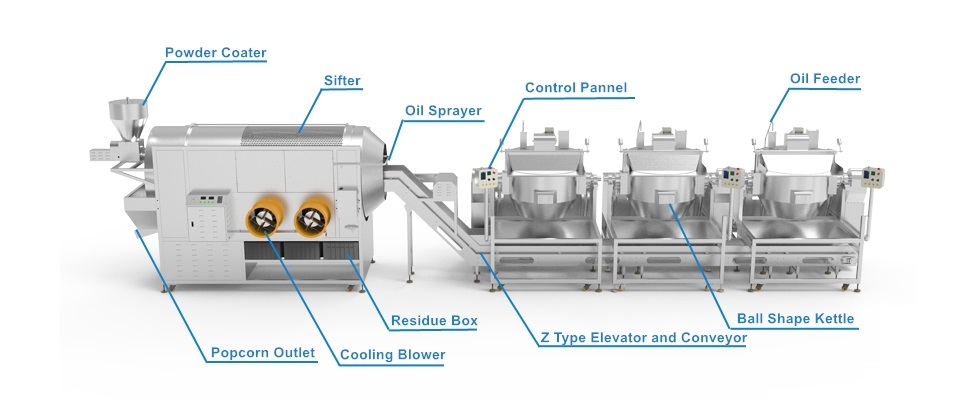
XFD offers industrial electromagnetic popcorn production equipment for factory applications. Its production-line options can integrate popping machines with oil feeding, conveying, cooling, and coating equipment. For example, the XFD industrial popcorn production and coating line uses electromagnetic heating technology and is listed with a capacity of approximately 60–80 kg/h for the specified configuration.
That figure applies to the referenced system and should not be treated as the output of every XFD machine. Actual production depends on the selected configuration, raw material, product requirements, and operating conditions.

Why Should Cooling and Filtering Be Included in the Diagnosis?
Uneven expansion should be identified as early as possible, ideally immediately after the popping stage. However, manufacturers should also inspect the downstream process because poor product handling can make an existing quality problem more noticeable.
After popping, popcorn may contain unpopped kernels, small fragments, and other unwanted materials. If these materials are not separated properly, they can affect the appearance and consistency of the finished product.
Cooling is also important before subsequent processing. Popcorn entering a coating stage at an unsuitable temperature may affect coating performance, depending on the recipe and process conditions. A properly matched cooling and filtering stage helps prepare the product for further handling.
XFD's rotating drum cooling and filtering machine is designed to cool popcorn and separate smaller unwanted materials. Its performance should be evaluated according to the actual production rate, product characteristics, and required separation results.
For manufacturers producing flavored popcorn, the next step is to check whether the coating system can handle the actual size and condition of the popped product. XFD's industrial popcorn coating machines provide options for different flavoring and coating applications.
It is important to remember that cooling and filtering equipment cannot correct poor kernel expansion. These machines help manage the product after popping. The original cause of uneven expansion still needs to be addressed at the raw material or popping stage.
How Can Manufacturers Prevent Uneven Popcorn Expansion in Daily Production?
Once the cause has been identified, factories should establish a repeatable production and inspection routine. The objective is not simply to correct one poor batch but to reduce the chance of the same problem happening again.
The following practices can help improve consistency:
- Set raw material acceptance standards: Define acceptable kernel moisture, size, variety, and physical condition with suppliers.
- Inspect every incoming delivery: Record moisture readings and check for damaged or inconsistent kernels before production.
- Maintain stable storage conditions: Protect kernels from excessive humidity, condensation, and unsuitable storage environments.
- Use controlled popping tests: Test new deliveries before introducing them into full-scale production.
- Standardize machine settings: Document the operating conditions that produce acceptable results for each kernel type.
- Maintain equipment regularly: Inspect heating systems, stirring mechanisms, sensors, and other important components.
- Track production performance: Record unpopped kernel rates, expansion volume, cycle time, and finished-product quality.
- Review downstream capacity: Make sure conveying, cooling, coating, and packaging equipment can handle the actual production output.
Manufacturers should also create separate production records for different kernel varieties. This makes it easier to identify which raw materials require different operating settings and reduces unnecessary trial and error.
What Should Buyers Check When Selecting a Commercial Popcorn Production Line?
For businesses planning a new popcorn factory or upgrading an existing facility, equipment selection should consider more than the machine's rated capacity. A high-output popping machine will not automatically deliver consistent finished popcorn if raw material feeding, cooling, coating, and packaging are not properly matched.
Before choosing a production line, buyers should prepare the following information:
- Target output: Required production capacity in kilograms per hour.
- Kernel specifications: Kernel variety, size, moisture range, and supplier information.
- Finished product: Desired expansion characteristics, texture, shape, and product quality requirements.
- Flavor requirements: Plain popcorn, caramel popcorn, cheese popcorn, or other flavored products.
- Automation level: Whether manual, semi-automatic, or fully automatic processing is preferred.
- Factory conditions: Available floor space, electrical supply, operator access, and cleaning requirements.
- Downstream processing: Required conveying, cooling, filtering, coating, and packaging capacity.
When discussing a project with XFD, providing these details can help the supplier evaluate a suitable machine configuration. XFD's equipment range includes individual machines and integrated production solutions, allowing manufacturers to consider their current production needs as well as future expansion.
For factories that need a complete workflow, the right arrangement should coordinate popping, material transfer, cooling, flavoring, and packing rather than treating each machine as an independent unit. You can also explore XFD's popcorn packaging equipment when planning the final stage of the production process.
Frequently Asked Questions About Uneven Popcorn Expansion
What is the most common cause of uneven popcorn expansion?
Inconsistent kernel moisture is one of the important causes, but kernel variety, size, hull damage, storage conditions, heating stability, and incorrect loading can also affect expansion. Manufacturers should check raw material quality and machine performance before deciding on a solution.
Why do some popcorn kernels pop while others remain unpopped in the same batch?
Kernels may have different moisture levels, sizes, hull conditions, or heat exposure. These differences can cause them to reach the required popping conditions at different times. Sampling the raw kernels and reviewing the popping cycle can help identify the cause.
Does kernel moisture affect popcorn expansion?
Yes. Moisture inside the kernel creates steam pressure during heating. Too little moisture may lead to poor expansion or unpopped kernels, while excessive or uneven moisture can make popping performance less predictable. The appropriate moisture range should be confirmed for the specific kernel variety.
How can manufacturers measure popcorn expansion consistency?
Manufacturers can compare expansion volume, unpopped kernel rate, finished popcorn size distribution, and batch-to-batch production results. Using the same sampling and measurement methods makes these indicators more useful for quality control.
Can increasing the heating temperature solve uneven popcorn expansion?
Not necessarily. Increasing temperature without identifying the cause may result in scorching or overprocessing. Manufacturers should first check kernel moisture, loading quantity, heating performance, and popping time before making controlled adjustments.
Can an industrial popcorn machine eliminate all unpopped kernels?
No. Natural differences in kernels and raw material quality mean that some variation can remain. A suitable industrial machine, consistent raw materials, and properly controlled operating conditions can help reduce unpopped kernels, but complete elimination should not be assumed.
Why should popcorn be cooled and filtered after popping?
Cooling helps prepare popcorn for subsequent processing, while filtering helps separate unpopped kernels, small fragments, and other unwanted materials. These steps improve product handling and help maintain consistency before coating or packaging.
What should a factory do when expansion quality suddenly becomes inconsistent?
Start by comparing the current raw material batch with a previously reliable batch. Check moisture, kernel size, and physical condition, then run a controlled popping test. If both batches show similar problems, inspect the heating system, loading quantity, stirring mechanism, and operating settings.
What information should buyers provide when requesting an industrial popcorn machine quotation?
Buyers should provide the target output in kg/h, kernel variety and specifications, desired popcorn products, coating requirements, automation preferences, factory space, and electrical supply. This information helps the supplier recommend equipment that matches the actual production process.
Uneven popcorn expansion is best solved through a systematic diagnosis rather than repeated adjustments to machine settings. By checking kernel quality, measuring moisture, testing popping performance, and reviewing equipment operation, manufacturers can identify the main source of inconsistency and reduce avoidable production losses.
For factories planning to improve production consistency or expand their manufacturing capacity, XFD Popcorn offers industrial popcorn machines and integrated equipment solutions for different production requirements. The right equipment configuration, combined with consistent raw materials and effective process control, helps manufacturers build a more predictable popcorn production operation.