Planning a popcorn factory is not simply about deciding where to install popcorn machines. A well-designed production line layout needs to connect raw material storage, popping, cooling, flavor coating, inspection, and packaging in a logical sequence. Each stage should have enough space and processing capacity to support the next one without creating unnecessary movement, product accumulation, or production delays.
So, what factors determine the best production line layout for a popcorn factory? The most important considerations are target production capacity, factory floor space, popcorn varieties, equipment configuration, material flow, food safety requirements, labor efficiency, and future expansion plans. The right layout should match the actual production process rather than simply placing machines wherever space is available.
For manufacturers planning a new facility or upgrading an existing factory, working with an experienced industrial popcorn machine manufacturer can help determine which equipment should be integrated and how the production stages should be arranged. XFD provides popcorn equipment and integrated production solutions for different manufacturing requirements.
What Determines the Best Popcorn Factory Production Line Layout?
The best popcorn factory layout is determined by how efficiently raw materials can move through every production stage and become finished, packaged products. A suitable layout should minimize unnecessary transportation, maintain a continuous workflow, provide enough operating space, and allow workers to access equipment for cleaning and maintenance.
Before selecting machines or drawing an equipment arrangement, manufacturers should evaluate several basic requirements:
- Production capacity: How many kilograms of finished popcorn must the factory produce per hour or per shift?
- Product variety: Will the factory manufacture plain popcorn, caramel popcorn, cheese popcorn, chocolate popcorn, or multiple flavors?
- Available factory space: What are the building dimensions, ceiling height, column positions, and available utility connections?
- Equipment configuration: Which machines are required for popping, feeding, cooling, coating, and packaging?
- Material flow: Can popcorn move between processing stages without unnecessary backtracking?
- Food safety: Can raw materials, processing areas, and finished products be managed with appropriate hygiene controls?
- Future expansion: Can additional machines or production modules be installed without redesigning the entire factory?
These factors are connected. For example, a factory targeting higher output may require multiple popping machines, larger cooling equipment, additional conveyors, and faster packaging capacity. Simply installing a larger popcorn popper will not solve production bottlenecks if the downstream equipment cannot handle the same volume.
How Does Production Capacity Affect Factory Layout?
Production capacity is one of the first factors to consider when designing a popcorn factory. The required output determines the number of popping machines, the size of the cooling and coating systems, the conveying arrangement, and the space needed for packaging and finished-product storage.
A small popcorn factory may operate with a relatively simple arrangement and some manual handling. A medium-sized facility may need multiple popping machines and dedicated cooling equipment. A large industrial factory generally benefits from an integrated production line that connects feeding, popping, cooling, coating, and packaging operations.
For reference, XFD offers different industrial production configurations, including an electromagnetic popcorn production line rated at approximately 80 kg/h and a two-machine configuration rated at approximately 160 kg/h. These are specifications for particular equipment arrangements, not universal production figures. Actual output depends on the product, operating conditions, and complete line configuration.
When evaluating an industrial system, manufacturers should check whether the quoted output refers to popped popcorn or finished flavored popcorn. They should also confirm the capacity of the cooling, coating, and packaging stages. A balanced production line is more useful than a high-capacity popping machine connected to slower downstream equipment.
For example, XFD's industrial electromagnetic popcorn production line with multiple machines uses two electromagnetic popcorn machines and is listed with a production capacity of 160 kg/h. Its configuration also includes automatic feeding, oil supply, discharge, and cooling and filtering equipment. This type of system is worth considering when planning a higher-volume factory layout.
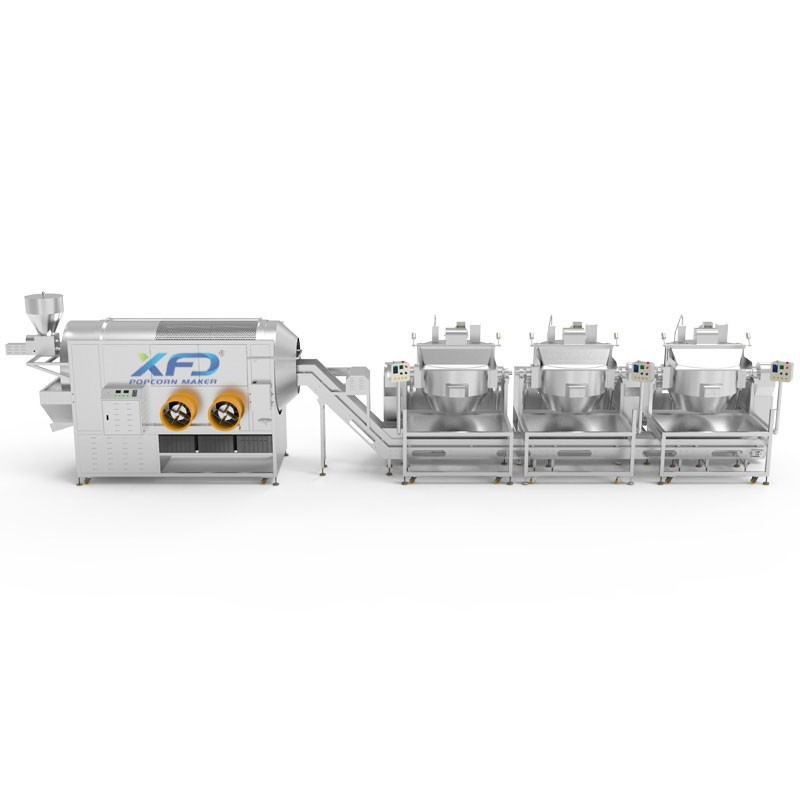
Industrial popcorn production equipment with multiple processing units.
Which Production Stages Should Be Included in a Popcorn Factory Layout?
A typical industrial popcorn factory needs several connected processing areas. The exact arrangement depends on the production method and product range, but most facilities include raw material storage, ingredient feeding, popping, cooling and filtering, flavor coating, inspection, packaging, and finished-product storage.
Raw material storage and preparation: Corn kernels, cooking oil, sugar, flavoring ingredients, and packaging materials should have designated storage areas. These areas need to be arranged so that materials can be supplied to production without blocking worker access or finished-product movement.
Ingredient feeding and popping: This is the main production stage. Kernel feeding, oil supply, heating, and popping should be arranged according to the selected machine configuration. If several popping machines operate together, the feeding and discharge systems should support their combined output.
Cooling and filtering: Freshly popped popcorn needs to be cooled and separated from unpopped kernels and small fragments before moving to subsequent processing stages. The cooling equipment should have enough capacity to prevent product accumulation after popping.
Flavor coating: Factories producing caramel, chocolate, cheese, or other flavored popcorn need suitable seasoning or coating equipment. Liquid coatings and dry powders may require different processing arrangements, so the coating area should be planned according to the actual recipes.
Inspection and packaging: Finished popcorn should be checked for product consistency before entering the packaging stage. Packaging equipment, weighing systems, bag materials, and finished-product handling areas should be positioned to avoid unnecessary product movement.
A practical factory workflow generally follows this sequence:
Raw Material Storage → Ingredient Feeding → Popcorn Popping → Cooling and Filtering → Flavor Coating → Quality Inspection → Packaging → Finished Product Storage
This sequence provides a useful starting point for factory planning. Some production systems combine several operations in one machine, while others require separate equipment and transfer conveyors. The final layout should reflect the selected machinery rather than assuming that every factory needs exactly the same arrangement.
Why Is Material Flow Important in Popcorn Factory Design?
Material flow determines how raw materials, semi-finished popcorn, and finished products move through the factory. A poorly arranged production line can create unnecessary handling, increase labor requirements, and cause product to accumulate between machines.
For example, if the popping equipment is installed far away from the cooling system, workers may need to move hot popcorn over a longer distance. If the coating machine is located in another area without a suitable conveyor, the factory may need additional manual handling. These arrangements can make production slower and more difficult to manage.
A more efficient layout keeps connected processing stages close enough to support smooth transfer while leaving sufficient room for equipment operation, inspection, and maintenance.
Manufacturers should pay attention to several practical details:
- Keep the movement of raw ingredients separate from the movement of finished products where required by the factory's hygiene plan.
- Use conveyors or elevators when manual transportation would create unnecessary labor or handling risks.
- Provide enough space around machines for workers to operate and clean them safely.
- Avoid placing equipment in a way that blocks emergency exits, maintenance access, or material delivery routes.
- Minimize repeated transfers between different production areas.
XFD's rotating vibrating drum sieve cooling and filtering machine is designed to cool popcorn and separate unwanted materials. Positioning this type of equipment between popping and coating can help create a more logical production flow, provided its capacity and installation dimensions match the rest of the line.
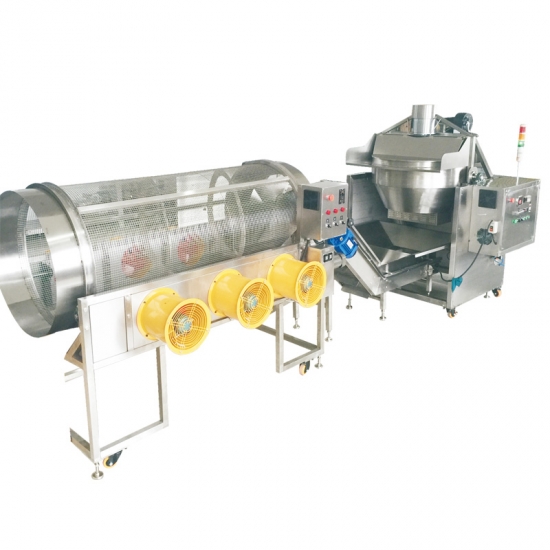
Cooling and conveying equipment helps connect different production stages.
How Does Product Variety Change the Production Line Layout?
The types of popcorn a factory plans to manufacture have a direct effect on equipment selection and production area design. Plain popcorn, caramel popcorn, cheese popcorn, and chocolate popcorn do not necessarily require the same coating process or ingredient preparation method.
Plain popcorn production: A factory mainly producing plain popcorn may need a popping system, cooling and filtering equipment, inspection facilities, and packaging machinery. The layout can be relatively straightforward because there is no complex flavor coating stage.
Caramel popcorn production: Caramel popcorn requires a suitable cooking and coating process. The layout should provide space for sugar ingredient preparation, caramelizing, mixing, cooling, and subsequent handling. The equipment arrangement should also allow operators to clean areas where sticky ingredients may accumulate.
Cheese and powdered seasoning popcorn: Dry seasoning applications may require a coating tumbler or powder distribution system. Ingredient storage and powder handling should be planned to reduce unnecessary dust and prevent cross-contact between different flavors.
Multiple-flavor production: Factories manufacturing several popcorn varieties need to consider ingredient changeovers, cleaning procedures, and production scheduling. Separate ingredient preparation areas or dedicated coating equipment may be appropriate depending on the product range and food safety requirements.
For manufacturers producing multiple flavors, XFD's popcorn coating and flavoring equipment can be evaluated according to the coating method, product characteristics, and required processing capacity. Selecting the right coating equipment early makes it easier to reserve the necessary floor space and utility connections.
How Much Factory Space Is Needed for a Popcorn Production Line?
There is no single factory size that suits every popcorn production line. The required floor area depends on the number and dimensions of machines, target output, level of automation, raw material storage, packaging requirements, and space needed for operators and maintenance.
A small factory with a simplified production setup may use a compact arrangement. A medium-sized factory may require separate areas for popping, cooling, coating, and packaging. A large industrial factory generally needs more space for multiple machines, conveyors, ingredient storage, finished-product handling, and equipment maintenance.
When planning the available floor area, manufacturers should not calculate space based only on the external dimensions of the machines. Additional space is needed for:
- Operator access and equipment loading or unloading.
- Routine cleaning, inspection, and maintenance.
- Electrical cabinets, power connections, and control systems.
- Raw ingredient storage and packaging material storage.
- Conveyor routes and product transfer areas.
- Finished product staging and temporary storage.
- Safe walkways and emergency access.
Ceiling height is also important. Some factories need elevated hoppers, feeding systems, or conveyors to transfer materials between machines. A layout that looks suitable on a two-dimensional floor plan may not work if there is insufficient vertical clearance.
Before finalizing the layout, request the machine dimensions, equipment weight, power requirements, connection points, and maintenance clearance from the supplier. A scaled equipment drawing is more useful than estimating machine positions from product photographs.
How Should Cooling and Packaging Areas Be Arranged?
Cooling and packaging are two important stages that should be considered together during factory planning. Popcorn that has just been popped or coated needs to reach suitable conditions before it is packed. If the cooling area is too small or the packaging equipment is too slow, finished product may accumulate and interrupt upstream production.
The cooling area should be positioned after popping or coating according to the selected process. Its capacity should match the amount of product entering the stage, while the transfer route should allow popcorn to move smoothly without excessive handling.
The packaging area should be arranged after product cooling and inspection. It should provide enough room for packaging materials, weighing and filling equipment, sealing operations, finished bags, and temporary product storage.
Packaging requirements also influence the layout. Retail snack bags, bulk wholesale packages, and microwave popcorn products may require different packaging equipment and material storage arrangements.
XFD provides fully automatic popcorn production and packing line solutions for factories looking to coordinate production and packaging operations. When planning this type of system, manufacturers should confirm the actual packaging format, filling speed, sealing requirements, and connection with the upstream production equipment.
What Food Safety and Hygiene Requirements Should Be Considered?
Food safety should be considered from the beginning of the factory layout design, not added after the equipment has already been installed. The arrangement should support hygienic ingredient handling, effective cleaning, contamination prevention, and controlled movement of products and personnel.
Raw ingredients, processing areas, and finished products may have different hygiene and handling requirements. Manufacturers should establish suitable storage conditions and production procedures based on the applicable food safety standards in their target markets.
Several layout details deserve attention:
- Separate material handling routes: Plan the movement of incoming ingredients, waste, and finished products to reduce unnecessary crossing.
- Provide cleaning access: Leave sufficient clearance around equipment, especially in areas where oil, sugar, and seasoning powders are handled.
- Use suitable food-contact materials: Confirm that product-contact components meet the relevant requirements for the intended food application.
- Manage dust and ventilation: Consider suitable ventilation and cleaning procedures in areas where dry powders or airborne particles may be present.
- Plan personnel access: Provide appropriate handwashing, changing, and hygiene facilities according to the factory's food safety plan.
- Control storage conditions: Protect ingredients and finished popcorn from moisture, pests, and unsuitable environmental conditions.
The layout should also leave enough space for routine maintenance and inspection. Equipment that is difficult to access may be harder to clean properly and can increase downtime during servicing.
Should a Popcorn Factory Choose a Manual, Semi-Automatic, or Fully Automatic Layout?
The automation level determines how much manual handling is required and how different machines communicate during production. It also affects equipment spacing, electrical planning, operator positions, and the overall investment budget.
Manual or simplified production layout: This arrangement may suit smaller operations with lower output requirements. Individual machines are positioned according to the production sequence, and workers handle some ingredient feeding, product transfer, or packaging tasks manually.
Semi-automatic production layout: This setup combines automated processing equipment with selected manual operations. It can be suitable for growing snack factories that want to improve production efficiency without investing in a fully automated system immediately.
Fully automatic production layout: A more integrated system can connect feeding, popping, conveying, cooling, coating, and packaging operations. It generally requires more detailed planning for control systems, equipment synchronization, and maintenance access, but can reduce repetitive manual handling.
XFD offers different industrial configurations for manufacturers with different output targets and automation requirements. The best option should be selected according to actual production demand, available floor space, labor availability, and expected return on investment.
How Can Manufacturers Avoid Production Bottlenecks?
A production bottleneck occurs when one processing stage cannot handle the volume produced by the previous stage. This is a common issue in factories where equipment is selected individually without considering the capacity of the complete production line.
For example, multiple popping machines may produce popcorn faster than a single cooling system can process it. Similarly, a high-capacity coating machine may be connected to packaging equipment that cannot handle the finished product at the same rate.
To prevent these problems, manufacturers should:
- Compare the rated and actual processing capacities of every major machine.
- Check whether the feeding and conveying systems can support the combined upstream output.
- Confirm that cooling and coating equipment can handle the required product volume.
- Match packaging speed with the expected finished-product output.
- Allow enough temporary buffer space between stages where necessary.
- Consider cleaning, flavor changeovers, maintenance, and planned downtime when calculating effective output.
A useful way to evaluate a production line is to identify the stage with the lowest effective capacity. That stage may determine the practical output of the entire factory, even if the popping equipment has a much higher rated capacity.
Manufacturers should also request a complete equipment arrangement rather than purchasing separate machines based only on individual specifications. This makes it easier to identify potential capacity mismatches before installation.
Why Should Future Expansion Be Considered During Factory Planning?
A popcorn factory layout should support current production requirements while leaving reasonable room for future development. Businesses may start with one production line and later need additional popping machines, coating systems, or packaging equipment as customer demand increases.
If the initial layout uses every available space, future expansion may require moving existing equipment, changing conveyor routes, or interrupting production. These changes can increase installation costs and create unnecessary downtime.
Manufacturers should consider reserving space for additional machines, future storage requirements, upgraded packaging systems, and expanded ingredient preparation areas. Electrical capacity, ventilation, and utility connections should also be evaluated before the factory is built or renovated.
Modular equipment arrangements can make future changes easier. For example, a factory may begin with a medium-capacity production line and later add another popping machine or increase coating and packaging capacity. Whether this is practical depends on the original equipment design and available utilities.
How Should You Plan the Best Production Line Layout for Your Popcorn Factory?
A good factory layout starts with production requirements, not machine dimensions alone. Before requesting an equipment proposal, manufacturers should prepare basic information about their products, expected output, factory space, and preferred automation level.
The following information can help an equipment supplier develop a more suitable production layout:
- Target capacity: Required finished popcorn output in kg/h and estimated daily production.
- Product types: Plain, caramel, cheese, chocolate, mushroom, butterfly, or multiple-flavor popcorn.
- Factory dimensions: Available floor area, building height, columns, doors, and access routes.
- Automation requirements: Manual, semi-automatic, or fully automatic production.
- Packaging requirements: Bag sizes, packaging materials, weighing methods, and expected packing speed.
- Utilities: Available electricity, ventilation, and other required factory connections.
- Expansion plans: Whether additional production capacity or new popcorn varieties are expected in the future.
It is also helpful to provide a factory floor plan with dimensions and mark the locations of existing utility connections. Equipment suppliers can then evaluate machine placement, transfer routes, and the space needed for operation and maintenance.
XFD specializes in popcorn machinery and industrial production solutions, including popping, cooling, coating, and packaging equipment. Its production systems can be evaluated according to different factory capacities and product requirements.
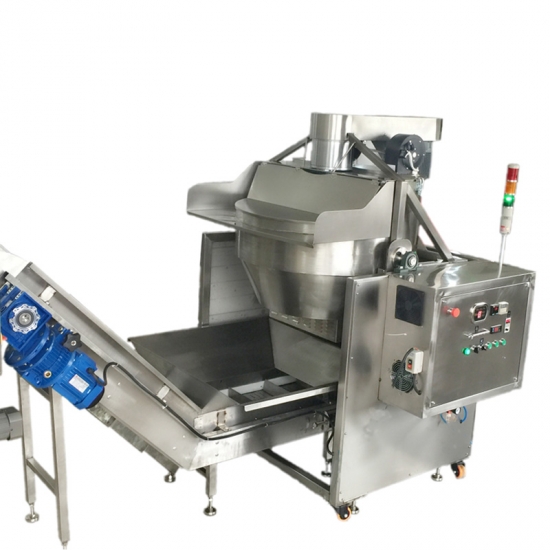
Industrial popcorn processing equipment should be arranged according to the factory's workflow and production requirements.
Whether you are building a new popcorn factory or upgrading an existing facility, choosing the right equipment configuration and production layout can help improve material flow, reduce unnecessary labor, and support consistent product quality. Contact XFD Popcorn to discuss your target output, product range, and factory layout requirements.
Frequently Asked Questions
What factors determine the best production line layout for a popcorn factory?
The main factors include production capacity, factory floor space, popcorn varieties, equipment configuration, material flow, food safety requirements, automation level, and future expansion plans. The layout should connect popping, cooling, coating, inspection, and packaging efficiently.
What equipment is needed for an industrial popcorn factory?
A typical industrial popcorn factory may require popcorn popping machines, ingredient feeding systems, oil supply equipment, conveyors, cooling and filtering machines, coating equipment, inspection facilities, and packaging machines. The exact configuration depends on production capacity and product type.
How should popcorn production equipment be arranged in a factory?
Equipment should generally follow the production sequence: raw material preparation, feeding, popping, cooling and filtering, flavor coating, inspection, and packaging. Connected stages should be positioned to reduce unnecessary transportation while providing sufficient cleaning and maintenance access.
How much space does a popcorn production line need?
The required space depends on machine dimensions, production capacity, automation level, storage requirements, and packaging arrangements. Manufacturers should also reserve space for operator access, maintenance, conveyors, utilities, and future equipment expansion.
How can a popcorn factory prevent production bottlenecks?
Manufacturers should match the processing capacity of popping, conveying, cooling, coating, and packaging equipment. The capacity of the slowest stage can limit the output of the entire line, so each major machine should be evaluated as part of one integrated system.
Is a fully automatic popcorn production line suitable for every factory?
Not necessarily. Fully automatic systems may suit factories with higher output requirements and standardized production processes. Smaller manufacturers may prefer manual or semi-automatic equipment depending on investment budget, available labor, product variety, and expected demand.
Why is cooling equipment important in a popcorn factory layout?
Cooling equipment helps reduce product temperature and separate unpopped kernels and small fragments before subsequent processing. Its capacity and position should match the popping and coating stages to prevent product accumulation and production delays.
What information should manufacturers provide when requesting a popcorn factory layout?
Manufacturers should provide the target output in kg/h, popcorn varieties, factory floor dimensions, available utilities, preferred automation level, packaging requirements, and future expansion plans. A dimensioned floor plan can help the supplier recommend a more suitable equipment arrangement.